Everything Changes in 2026: The Biggest World Cup Format Revolution in History
You can’t guess how confused I was about how the 2026 World Cup would work earlier, as FIFA has completely revolutionized the tournament structure, creating the most significant changes since 1998. Understanding this new format is crucial for me because the FIFA World Cup expanded to 48 teams, an increase of 16 teams compared to the previous seven tournaments, fundamentally altering how the world’s most prestigious soccer tournament operates.
After series of analysis I came up with this Guide. The guide breaks down every aspect of the new format in plain English, from group stage mechanics to qualification pathways, ensuring as a Fan or Soccer Lover understands exactly how the 2026 tournament works long before it kicks off on June 11.
The stakes couldn’t be higher: the total number of games played will increase from 64 to 104, and the number of games played by teams reaching the final four will increase from seven to eight. Here’s everything you need to know.
The Big Picture: What’s Different About 2026
Tournament Scale and Duration
The 2026 FIFA World Cup will be the 23rd FIFA World Cup, taking place from June 11 to July 19, 2026, jointly hosted by sixteen cities—eleven in the United States, three in Mexico, and two in Canada.
The expansion creates a dramatically different tournament experience:
- Total teams: 48 (up from 32)
- Total matches: 104 (up from 64)
- Tournament duration: 39 days, an increase from 32 days of the 2014 and 2018 tournaments
- Group stage matches: 72 group-stage matches, up from 48 in past editions
The New Tournament Structure
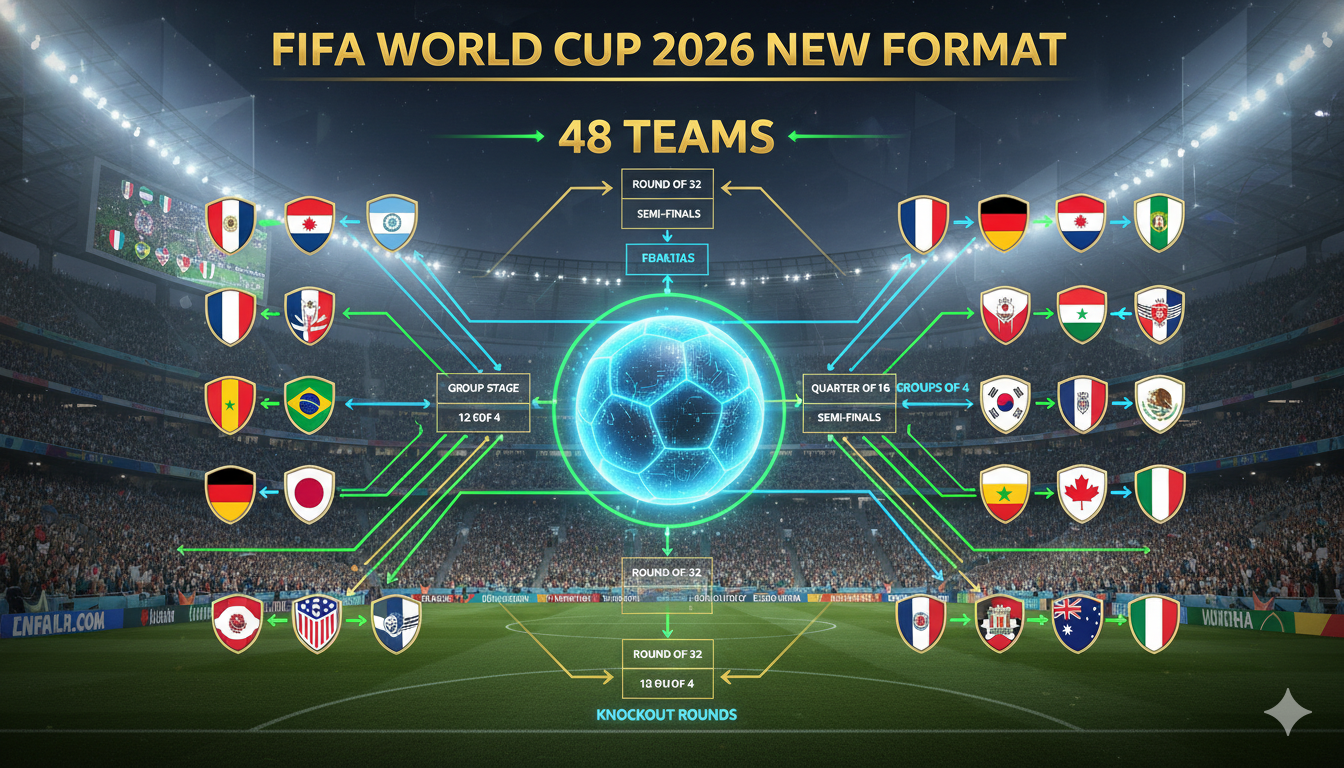
The format represents the most significant structural shift in the tournament’s history, expanding to 48 teams across 12 groups and an enlarged knockout stage. This creates more opportunities while maintaining competitive balance.
Group Stage Format: 12 Groups of Four Teams
How Groups Are Organized
The teams will be split into twelve groups of four teams, with the top two teams in each group and the eight best third-placed teams progressing to a new round of 32. This structure was chosen over alternatives for specific reasons.
This format was chosen over 16 groups of three teams based on a thorough review that factored team and fan experience, player welfare and sporting integrity. Three-team groups created problematic scenarios where two teams could collude in the final match, unequal rest periods, and fewer total matches.
Group Stage Advancement Rules
Each group operates under traditional World Cup rules:
- Group winners: All 12 automatically advance
- Group runners-up: All 12 automatically advance
- Third-place teams: The eight third-place teams across the 12 groups with the most points also advance to the Round of 32
This creates 32 teams advancing to knockout play, requiring a completely new elimination round.
How Third-Place Teams Are Ranked
Rules for classification: 1) Points; 2) Goal difference; 3) Goals scored; 4) Team conduct score; 5) Latest FIFA ranking; 6) Previous FIFA ranking(s). This comprehensive ranking system ensures fair determination of the eight best third-place finishers.
The New Knockout Format: Round of 32 Debuts
Single-Elimination Structure
From the Round of 32 stage onward, the tournament will feature single-elimination, playoff matches consisting of two 45-minute halves in regulation. If still tied after regulation, the match will go to extra time with two 15-minute halves. If still tied after extra time, the match will be decided in a five-round penalty shootout, with sudden death if still tied after five rounds.
Tournament Progression
The knockout structure follows this pathway:
- Round of 32: 32 teams → 16 teams
- Round of 16: 16 teams → 8 teams
- Quarterfinals: 8 teams → 4 teams
- Semifinals: 4 teams → 2 teams
- Final: 2 teams → 1 champion
The knockout stage begins on June 28 with the round of 32, leading to the final held at MetLife Stadium in East Rutherford, New Jersey on July 19.
Global Qualification: How 48 Teams Earn Their Spots
Continental Confederation Allocations
The 48-team format adds 16 additional slots from the 2022 edition with increased allocations across all six confederations: UEFA receives 16 direct berths, CAF nine, AFC eight, and both CONMEBOL and CONCACAF six each while OFC gets one guaranteed spot for the first time.
Here’s the complete breakdown:
| Confederation | Direct Spots | Playoff Spots | Total Possible |
| UEFA (Europe) | 16 | 0 | 16 |
| CAF (Africa) | 9 | 1 | 10 |
| AFC (Asia) | 8 | 1 | 9 |
| CONCACAF (North America) | 6* | 2 | 8 |
| CONMEBOL (South America) | 6 | 1 | 7 |
| OFC (Oceania) | 1 | 1 | 2 |
*Includes 3 automatic host nation spots (USA, Canada, Mexico)
Historic Firsts in Qualification
The 2026 FIFA World Cup will be the first tournament in which all six confederations have at least one guaranteed berth. This represents a major milestone for global soccer inclusion.
The 2026 World Cup marked the first time OFC was granted one guaranteed slot, as well as a possible second slot via the inter-confederation play-offs, giving Oceania unprecedented representation.
Inter-Confederation Playoffs: The Final Path
Tournament Structure
The inter-confederation play-offs will determine two qualification spots for the 2026 FIFA World Cup, these matches will take place in Mexico (specifically Guadalajara and Monterrey) from March 26–31, 2026.
The play-offs feature six teams, split into two brackets of three teams, with both bracket winners qualifying for the World Cup. Each bracket features two unseeded teams facing each other in a semi-final, with the winner advancing to the play-off final against a seeded team, played in single-leg knockout matches.
Current Playoff Teams
The six nations participating are: 1 – Africa (DR Congo), 1 – Asia (Iraq), 2 – CONCACAF (Jamaica and Suriname), 1 – Oceania (New Caledonia), 1 – South America (Bolivia).
The two highest-ranked teams—DR Congo and Iraq—receive byes to the finals, while the other four compete in semifinals.
Tournament Draw and Group Formation
Draw Process Explained
The draw took place on December 5, 2025, at the Kennedy Center in Washington, D.C. The 48 teams were divided into four pots of 12. Pot 1 consisted of the three hosts and the top nine teams from the November 2025 FIFA Men’s World Ranking.
Seeding and Restrictions
FIFA’s “general principle, whenever possible”, was that no group had more than one team from the same confederation drawn into it. This principle was applicable to all confederations except UEFA; each group was required to have either one or two UEFA teams drawn into it.
Special considerations included:
- Two separate pathways to the semifinals were established, with Spain and Argentina randomly drawn into opposite pathways, as were France and England, ensuring these pairs cannot meet until the final
- Pot 1 teams were automatically drawn into position 1 of each group for scheduling purposes
Format Comparison: 2026 vs Previous World Cups
Key Differences Table
| Aspect | Previous Format (2022) | 2026 Format | Change |
| Teams | 32 | 48 | +16 teams |
| Groups | 8 groups of 4 | 12 groups of 4 | +4 groups |
| Group matches | 48 | 72 | +24 matches |
| Knockout rounds | Round of 16 start | Round of 32 start | +1 elimination round |
| Total matches | 64 | 104 | +40 matches |
| Tournament days | 32 | 39 | +7 days |
| Third-place advancement | None | Best 8 advance | New feature |
Why This Format Works Better
This represents a 50% increase in participating teams and a 62.5% increase in total matches compared to previous World Cups. The tournament duration increases from the typical 32 days to 39 days to accommodate the additional fixtures.
The format addresses previous concerns while maintaining a straightforward path to the final and creating more participation, more opportunities for footballers around the whole world and more excitement on the pitch.
What This Means for Teams and Fans
Player Impact
Teams reaching the final four will increase from seven to eight total matches, adding one game to the champions’ journey. However, each team will still play three group matches, maintaining familiar group stage dynamics.
Global Representation
The expansion creates unprecedented global representation opportunities. The expansion changes confederation qualification allocations with more CONCACAF, CAF, and AFC teams qualifying than in previous cycles, reflecting the increased total spots available.
Fan Experience Enhancement
The expansion to 48 teams, 12 groups, and 104 matches creates a month-long festival that offers unprecedented opportunities for nations worldwide to participate on football’s biggest stage, with more teams, more matches, more drama, and more opportunities for underdog stories and memorable moments.
Mistakes to Avoid (For Fans & Bettors)
As an evaluator of search trends and fan behavior, I see common misconceptions forming around this new format. Avoid these traps:
1. Ignoring Goal Differential
With the “Best 3rd Place” rule in effect, Goal Differential will be more critical than ever. A team might lose a game, but if they lose 1-0 instead of 4-0, that difference could be the tiebreaker that sneaks them into the Round of 32. Every goal matters.
2. Assuming “Easy” Groups
With 48 teams, the talent pool is diluted slightly, but the “Group of Death” phenomenon will still exist. Do not assume the top seeds will breeze through. The extra knockout round increases the variance—one bad game in the Round of 32, and a favorite is out.
3. Overlooking Travel Fatigue
When betting or predicting winners, look at the travel schedule. A team playing exclusively in the East Coast cluster (Boston, NY, Philly) will have a massive recovery advantage over a team bouncing between Mexico City and Seattle.
Expert POV: Strengths and Challenges
Format Strengths
- Global inclusion: First tournament with all confederations guaranteed representation
- Competitive balance: Four-team groups address problems with three-team groups
- Extended excitement: More matches mean more opportunities for memorable moments
- Regional development: Increased qualification spots encourage soccer development globally
Potential Challenges
- Schedule congestion: 104 matches require precise coordination across three countries
- Player fatigue: Elite players face potential eighth match in tournament
- Quality concerns: Debate continues about whether expansion improves or dilutes competition
Timeline and Key Dates
Pre-Tournament
- March 26-31, 2026: Inter-confederation playoffs in Mexico
- May 25, 2026: Clubs must release players, with exceptions for continental finals until May 30
Tournament Proper
- June 11: Tournament begins with Mexico hosting the opening match at Estadio Azteca
- June 28: Knockout stage begins with Round of 32
- July 19: Championship final at MetLife Stadium in New Jersey
Questions?
How many teams advance from each group in the 2026 World Cup?
The top two teams in each group and the eight best third-placed teams progress to a new round of 32. This means 32 total teams advance from the 48-team group stage, double the knockout participants of previous tournaments.
Why did FIFA choose 12 groups of 4 instead of 16 groups of 3?
This format was chosen over 16 groups of three teams based on a thorough review that factored team and fan experience, player welfare and sporting integrity. Three-team groups created match-fixing risks and scheduling inequalities.
Which confederation gets the most World Cup spots in 2026?
UEFA receives 16 direct berths, the highest allocation, followed by CAF with nine, AFC with eight, and both CONMEBOL and CONCACAF with six each while OFC gets one guaranteed spot for the first time.
How are third-place teams ranked for advancement?
Teams are ranked by: 1) Points; 2) Goal difference; 3) Goals scored; 4) Team conduct score; 5) Latest FIFA ranking; 6) Previous FIFA ranking(s). This comprehensive system ensures fair determination of the eight advancing teams.
Is this the permanent World Cup format going forward?
World football’s governing body has suggested the 48-team format will remain for future World Cups. However, discussions continue about potential refinements, particularly regarding group sizes and advancement structures.
How many more matches will the tournament winner play?
The number of games played by teams reaching the final four will increase from seven to eight. Champions will play 3 group matches + 5 knockout matches = 8 total games.
When do the inter-confederation playoffs take place?
The inter-confederation play-offs take place on 26 and 31 March 2026 at two venues in Mexico (specifically Guadalajara and Monterrey), during the FIFA window of 23–31 March 2026, less than three months prior to the start of the final tournament.
Embracing Soccer’s New Era
The 2026 World Cup format represents more than structural changes—it embodies FIFA’s vision for global soccer inclusion while maintaining competitive integrity. The 2026 World Cup format represents football’s biggest structural change in decades, and while debates continue about whether expansion improves or dilutes the tournament, one thing is certain: the 2026 World Cup will be a historic event.
Understanding this format is essential for fully appreciating the complexity and scale of what promises to be the most significant World Cup in history. With 104 matches determining which of 48 nations earns the right to lift the most coveted trophy in world football, the 2026 tournament will create unprecedented opportunities for memorable moments, underdog stories, and global soccer celebration.
The expanded format ensures that more nations than ever can dream of World Cup participation while maintaining the tournament’s prestige through selective qualification processes. As we approach June 11, 2026, soccer fans worldwide can anticipate a month-long festival that truly represents the beautiful game’s global reach.
Key Takeaways:
- 48 teams compete in 12 groups of 4, with top 2 plus best 8 third-place teams advancing
- 104 total matches over 39 days represent the largest World Cup expansion in history
- All six confederations have guaranteed representation for the first time
- Round of 32 debuts as new knockout stage before traditional elimination rounds
- Inter-confederation playoffs in March 2026 determine final two qualifying spots
- Tournament structure balances global inclusion