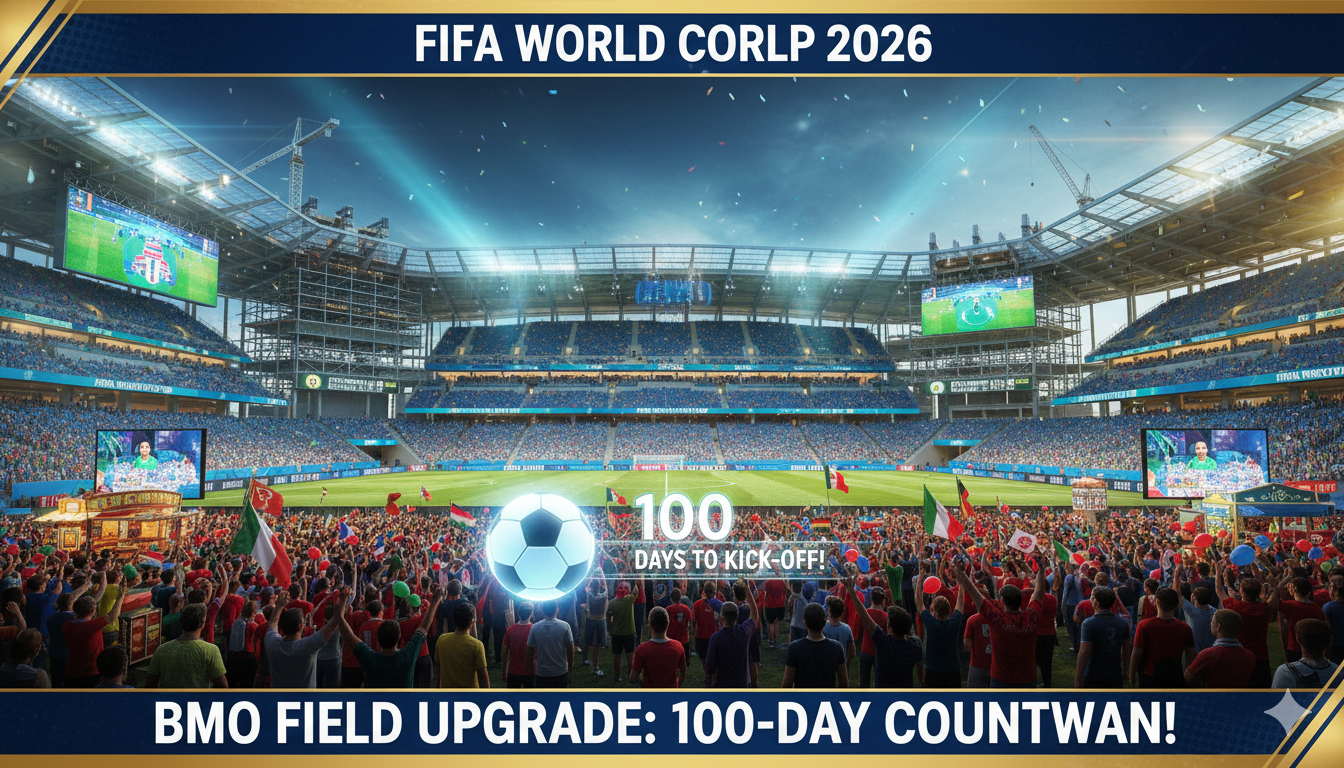
With less than 100 days until FIFA World Cup 2026 kicks off, Toronto’s preparations are reaching fever pitch as major infrastructure projects near completion and official fan destinations are finally unveiled.
I can see that Toronto is officially less than 100 days away from hosting the world’s biggest sporting event. The FIFA World Cup 2026, hosted by Canada, the United States and Mexico, kicks off June 11 and Toronto will host a handful of games alongside Vancouver.
The countdown milestone brings clarity to two crucial questions that have dominated discussions among Toronto soccer fans: How will BMO Field accommodate FIFA’s demanding requirements, and where will the thousands of ticketless supporters experience the tournament?
My guide would assist on things to be revealed about BMO Field’s massive transformation and Toronto’s official fan zone locations as the city enters its final sprint toward hosting six World Cup matches. Putting you Fan’s at an accurate angle in getting dynamic information in readiness for the FIFA World Cup 2026.
BMO Field’s Massive $146 Million Transformation
Toronto’s BMO Field is undergoing one of the largest renovations of all 16 FIFA World Cup renovations ahead of the tournament starting in June. The stadium’s seating capacity is being increased to 44,000 seats.
Phase 1 Complete: Permanent Upgrades Already Installed
Sharon Bollenbach, executive director for the FIFA World Cup 26 Toronto Secretariat, said phase one of the renovations is officially complete, and includes several permanent elements such as luxury suites, an upgraded video production control room and a new kitchen.
The completed Phase 1 improvements represent the foundation for Toronto’s World Cup readiness:
New Luxury Amenities:
- New luxury boxes and a rooftop patio with capacity for 1,000 fans will be added to the north side of the stadium, the city says along with a new centre-field lounge on the stadium’s west side.
- The lounge was made by combining what used to be four individual suites for fans and sits right at the centre of the field. Eaves says this newly created lounge is also intended for world leaders, which he expects could potentially attend the games.
Technology Enhancements:
- As part of the upgrades, four new 50 x 30 video boards have been attached to the stadium’s corner columns which includes improved resolutions across more than 50 million LED pixels. They will be staying in the stadium after the World Cup.
- The field is also being prepared for the increased capacity of fans by opening a new and improved west kitchen to serve fans more efficiently, and the stadium will also feature improved concession and concourse areas, including self-serve technology.
Phase 2: The Major Capacity Expansion Challenge
The most dramatic changes are still to come. Phase 2 construction is set to begin in December and will include the installation of 17,000 new temporary seats. Bollenbach says this will be done by installing 10,000 new seats in the north end of the stadium and 7,000 in the south, bringing the stadium’s 28,000 capacity to 45,000 to meet FIFA requirements.
Construction Timeline and Handover:
- We have to hand the stadium over to FIFA 30 days before the first match, so May 12, 2026, so between now and then, there’s a lot of work to do.
- Substantial completion is set for end of March on the multi-phased project being built by a general contracting partnership between PCL and Arena Group.
Temporary vs Permanent Elements Explained
The project has both temporary and semi-permanent elements. Sickman says the added seating is temporary, “the likes you saw in Russia,” with temporary seating pushing outside the typical stadium design. But there’s also a semi-permanent overlay that adds additional hospitality for the World Cup that stadium owners Maple Leaf Sports & Entertainment can choose to keep indefinitely.
Legacy Features:
- The seating itself is temporary, but there will be some great legacy elements that stay and improve fan experience in the stadium long term. After the temporary seating on the hospitality area gets taken down, the venue will convert it into a rooftop patio for Toronto FC, Toronto Argonauts and other events.
Fan Reactions to Temporary Construction
The dramatic appearance of BMO Field’s expansion has sparked significant discussion among fans. It’s a huge change for the almost 20-year-old facility, but the temporary nature of the new bleachers under construction at the south end of the venue has some fans feeling uneasy. Photos of the stadium shared by local photographer Kotsy have sparked debate about the stadium experience awaiting fans in the temporary bleachers.
However, construction experts point to successful precedents. While others had similar feelings about the sturdiness of the new build, many chimed in with examples of similar constructions that have endured decades of temporary use with no issues. The so-called “temporary” stand at Gillingham FC’s Priestfield Stadium has been in use for nearly 25 years.
Official Fan Zone Locations: Fort York and The Bentway
After months of speculation, Toronto has confirmed the official locations for its FIFA Fan Festival experience.
Fort York National Historic Site: Where History Meets Football
The City of Toronto has confirmed Fort York National Historic Site and The Bentway as the official venues for FIFA Fan Festival™ Toronto, marking a milestone in the city’s preparations to welcome the FIFA World Cup 2026™.
Historical Significance:
- Fort York National Historic site is located near Bathurst Street and Fort York Boulevard. It is a park with ample history, but is most well known as the location of the Battle of York during the War of 1812.
- Fort York, with its roots stretching back to the late 18th century, is where Canada defended its shores during the War of 1812. The site now stands as a national historic landmark and archeological park, a green expanse nestled amid urban sprawl.
The Bentway: Urban Innovation as World Cup Venue
The Bentway is an outdoor public space located below the Gardiner Expressway that aims to re-imagine the opportunities of urban spaces. It opened in 2018 to demonstrate what’s possible for the space under the Gardiner.
Unique Architectural Setting:
- A stunning outdoor public space located below the elevated Gardiner Expressway in west downtown Toronto, The Bentway has become known as a both a beloved backyard park and one of the city’s top creative destinations. As operators and programmers of the site, The Bentway Conservancy is an independent not-for-profit and registered charity fuelled by a mission to ignite the urban imagination.
Fan Festival Programming and Experience
The FIFA Fan Festival™ will bring fans together to celebrate the world’s largest sporting spectacle, showcasing Toronto’s unique cultural vibrancy through art, music and food while offering a free and inclusive space for residents and visitors to connect through the power of sport. The FIFA Fan Festival™ will run between Thursday, June 11 and Sunday, July 19, 2026 and will feature live match broadcasts on large screens, diverse cultural performances, interactive installations and a variety of local food experiences.
Capacity and Accessibility:
- Bollenbach said the Fan Fest space can hold as many as 20,000 people at a time. Andrew Weir, the president and CEO of Destination Toronto told CP24 on Tuesday that “tens of thousands” of visitors are expected “on a daily basis” in June.
Strategic Location Benefits
In addition to their rich cultural offerings, both locations are ideal for the FIFA Fan Festival™ thanks to their proximity to transit and to Toronto Stadium.
Transportation Access:
- Transport: TTC Streetcar 509/511 to Strachan Ave; 15 min walk from Union Station; bike share Citi Bike equivalent available
- On match days, most fans funnel through Union Station, then hop on the 509 or 511 streetcar west to Exhibition Loop. It’s a direct ride, no transfers, and the crowd energy builds naturally as you approach. Walking is realistic if you’re staying in Liberty Village, Fort York, or King West.
Toronto’s World Cup Match Schedule and Economic Impact
Six Matches Including Historic Opener
FIFA World Cup 26™ Toronto will host six matches during the FIFA World Cup 2026™, beginning with the first-ever men’s FIFA World Cup™ match on Canadian soil on Friday, June 12, 2026 and a round of 32 match on Thursday, July 2, 2026.
Complete Match Schedule:
- BMO Field in Toronto, will host six matches during the 2026 FIFA World Cup, with five group stage matches scheduled to be played on June 12, 17, 20, 23 and 26, and one round of 32 match scheduled for July 2.
Projected Economic Benefits
In December 2024, FIFA released an economic impact assessment, prepared by Deloitte Canada, estimating that FIFA World Cup 26™ could generate up to $940 million in positive economic output for the Greater Toronto Area. This includes a projected $520 million in GDP growth, $340 million in labor income and $25 million in government revenue. The tournament is also expected to create more than 6,600 jobs between June 2023 and August 2026, providing a substantial boost to the region’s economy.
Financing the World Cup Dream: Who Pays What
Total Project Costs
Hosting the tournament is expected to cost the city of Toronto $380 million, according to a 2024 report, a long way from the initial projected costs in 2018 of $30 to $45 million. The provincial and federal governments have committed roughly $100 million each to help the city pay for the hosting gig.
BMO Field Renovation Breakdown:
- The city and MLSE are spending $123 million and $23 million, respectively.
- The City of Toronto has approved a $37 million contract to temporarily increase the capacity of BMO Field. The city council voted in favour of the temporary expansion contract to allow the stadium to meet FIFA’s capacity requirements of more than 45,000 fans.
What Makes This Transformation Unique
Only Soccer-Specific Stadium in North America
BMO Field in Toronto, Ontario, is the only soccer-specific stadium in the United States or Canada to be awarded host venue status at World Cup 2026. It was built for Toronto FC, an expansion club that first competed in Major League Soccer in the 2007 season.
Smallest World Cup Venue with Biggest Heart
‘Toronto Stadium’ will be the World Cup’s smallest venue, but has received its second significant upgrade in the last ten years, which will see it increase capacity to 45,000, allowing home fans to watch Canada’s opener at the city’s first-ever men’s World Cup fixture.
Tips for Great Experience at Toronto’s World Cup
Fan Zone Strategy
Toronto’s official fan festival sites are split between Fort York National Historic Site and The Bentway, both walkable from the stadium area. These aren’t fenced-in viewing pens, rather, they feel like extensions of the city, with food stalls, music, and families drifting in and out.
Alternative Viewing Options
Sports Bars and Local Venues:
- Sports bars skew soccer-literate. Places like The Football Factory or Scotland Yard don’t need explanations when a chant starts. If you want scale, Real Sports delivers wall-to-wall screens and neutral ground for mixed supporters.
Community Spaces:
- Between matches, locals default to parks. Trinity Bellwoods and High Park become social hubs, not sightseeing stops. You’ll see pickup games form organically, often involving people who met on the streetcar an hour earlier.
Avoid these During Toronto’s World Cup
Underestimating Transit Time: While Toronto’s public transit system is extensive, match days will see unprecedented crowds. Plan extra travel time and consider alternative routes.
Assuming Fan Festival Requires Registration: The Fan Festival is being consciously designed as a public commons — a no-ticket-needed space for people from all walks of life. With many residents unable to afford match tickets, the festival becomes their front-row seat.
Overlooking Accommodation Location Impact: Accommodation choice changes your experience more than ticket category. Downtown Core puts you near transit hubs and late-night food. Queen West and the Annex lean creative and local, with bars that turn into unofficial watch spots. Liberty Village sits closest to the stadium and fills with pre-match buzz hours before kickoff.
Ignoring Weather Considerations: June and July in Toronto can be hot and humid. The outdoor fan zones will require sun protection and hydration planning.
How Toronto Compares to Other Host Cities
North American Renovation Scale
But while not a single new constructed stadium is on the docket—a World Cup rarity—renovations are underway at all 16 venues ahead of the tournament’s June 11 start. Each stadium is accustomed to hosting either National Football League or global-level football and mostly require minor tweaks, field-sized adjustments and hospitality and VIP area upgrades ahead of the World Cup.
Toronto’s BMO Field, however, required heavy lifting to host the world’s most popular sporting event. Built to hold just under 28,000 fans when it won an ENR Global Best Projects award in 2017, the eastern-most venue of the two Canadian hosts is undergoing a reported $146-million renovation to expand to more than 44,000 capacity.
Your Questions Answered:
When will BMO Field’s renovations be completely finished?
Phase 2 construction will be complete by May 12, 2026, when the stadium must be handed over to FIFA 30 days before the first match. Phase 1 permanent upgrades are already complete, while the major temporary seating expansion begins in December 2025.
Are the fan zone locations free to access?
Yes, the FIFA Fan Festival will feature live match broadcasts on large screens and will be specifically designed for fans to enjoy free live broadcasts of the tournament’s matches while experiencing an official FIFA atmosphere. No tickets are required for Fort York and The Bentway fan zones.
How do I get to the fan zones from downtown Toronto?
Take TTC Streetcar 509/511 to Strachan Ave, or walk 15 minutes from Union Station. Both locations are easily accessible via public transit and walking from major downtown hotels.
Will BMO Field keep any upgrades after the World Cup?
The seating itself is temporary, but there will be some great legacy elements that stay including converting the hospitality area into a rooftop patio for Toronto FC, Toronto Argonauts and other events. The new video boards, luxury suites, and enhanced facilities will remain permanently.
What’s the capacity difference between regular BMO Field and World Cup configuration?
The stadium’s seating capacity is being increased from close to 30,000 to 45,000 — with 17,000 temporary seats being added on grandstands at the north and south ends of the field.
Can I visit both fan zone locations during the same day?
Yes, the venues are located next to one another and are both walkable from the stadium area. Fans can easily move between Fort York and The Bentway throughout the tournament days.
How early should I arrive at the fan zones for popular matches?
While specific capacity management details haven’t been announced, the Fan Fest space can hold as many as 20,000 people at a time with “tens of thousands” of visitors expected “on a daily basis” in June. Arriving 2-3 hours before kickoff for high-demand matches is recommended.
Key Takeaways
Toronto’s 100-day countdown reveals a city transforming itself to welcome the world’s biggest sporting event. BMO Field’s unprecedented $146 million renovation represents the largest World Cup venue upgrade in North America, converting a modest 28,000-seat soccer stadium into a 45,000-capacity showcase worthy of hosting Canada’s first-ever men’s World Cup matches.
The selection of Fort York National Historic Site and The Bentway as official fan zone locations demonstrates Toronto’s commitment to accessibility and cultural celebration. These venues offer free, public spaces where the estimated tens of thousands of daily visitors can experience World Cup atmosphere without match tickets.
With Phase 1 permanent upgrades complete and Phase 2 temporary expansion beginning in December, Toronto faces an ambitious timeline. The city must hand over a FIFA-ready venue by May 12, 2026, while simultaneously preparing fan zones capable of handling unprecedented crowds across 39 tournament days.
The economic projections of $940 million in regional impact underscore the magnitude of this opportunity for Toronto. However, the true measure of success will be whether the city can deliver an authentic, accessible World Cup experience that reflects its multicultural identity while meeting FIFA’s exacting standards.
As Toronto enters its final sprint toward June 11, 2026, the convergence of historical venues, cutting-edge stadium technology, and grassroots fan celebration promises a uniquely Canadian contribution to football’s greatest tournament. The next 100 days will determine whether these ambitious plans translate into World Cup magic.