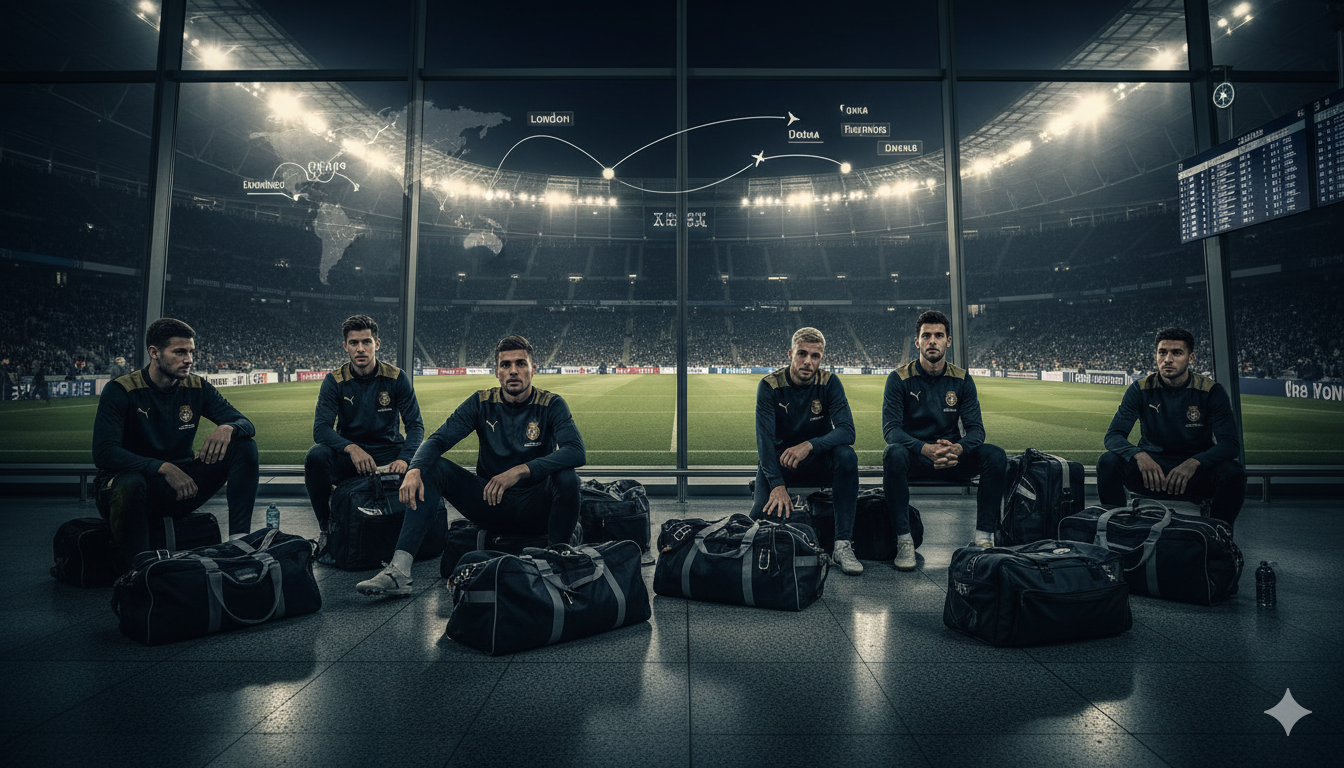
The stage is set for an unprecedented collision between European football’s most demanding club competition and the largest, most geographically dispersed World Cup in history. As the Champions League embraces a new Swiss round system, expanding from 64 to 36 teams and increasing matches from 48 to 144, players are enduring a grueling schedule that heightens fatigue and tests their physical limits. Now, you will agree with me that, these exhausted stars must prepare for a World Cup spanning three countries and 16 cities—a recipe for performance disaster.
The numbers paint a stark picture: research suggests that every additional 16,000 kilometers traveled equates to a 3 percent decrease in points for teams. With Europe’s elite already stretched to breaking point by Champions League demands, the 2026 World Cup’s continental scale threatens to expose the physical limitations of even the world’s fittest athletes.
The Perfect Storm: UCL Exhaustion Meets Continental Chaos
Champions League’s New Burden on Elite Players
The 2024-25 Champions League season marked a pivotal transformation that fundamentally altered player workload calculations. The total distance traveled by all clubs in this season’s Champions League has already surpassed 305,000 kilometers, more than in the previous two seasons combined. This dramatic increase represents more than statistical curiosity—it reflects a systemic shift toward player exhaustion.
Long-distance travel affects football performance, and the new Champions League format is only making things worse. Players are not just fatigued by more matches, but also by longer travel hours. The implications extend far beyond European competition, creating a foundation of accumulated fatigue that will prove devastating when combined with World Cup demands.
The Science Behind Travel-Induced Performance Decline
Professional sports science has definitively established the relationship between travel distance and athletic performance deterioration. Recent research underscores the pervasive impact of long-distance travel on athlete performance, with studies highlighting that fatigue resulting from travel is a significant factor influencing outcomes on the pitch, as the human body experiences disruptions in sleep patterns and dietary habits while traveling.
These physiological disruptions manifest in measurable performance metrics. Increased distances covered at higher speeds impose greater physiological and biomechanical demands on the body, leading to increased fatigue, suggesting that winning was physically more demanding for offensive players but losing was more demanding for defensive players.
2026 World Cup: The Continental Challenge
Unprecedented Geographic Scale
The 2026 World Cup across three countries provides more complex travel arrangements than Qatar 2022, for obvious reasons given the smaller size of that host nation. The tournament’s scope creates logistical nightmares that dwarf previous competitions. An England supporter following a group-stage run of Dallas, Boston, and New York will travel roughly 2,800 kilometres, generating around 360 kg of CO₂e—and that’s just for fans.
For players, the distances become exponentially more challenging. By far and away, the biggest logistical hurdle for the 2026 World Cup will be distance as I foresee. Teams could face scenarios requiring travel from Vancouver to Miami—a journey exceeding 3,400 miles—while maintaining peak physical condition for elite competition.
Time Zone and Climate Disruption
The tournament spans four time zones and diverse climatic conditions, from Seattle’s temperate Pacific Northwest to Miami’s subtropical humidity. Travel fatigue can alter circadian rhythms, disrupting the personal patterns of fine-tuned players like the usual rhythms of a 90-minute game.
This physiological disruption compounds the physical demands already accumulated during Champions League campaigns. These long multi-leg trips can create fatigue, especially when adjusting to new time zones and high altitudes. Extra comfort, more space, and the ability to rest on long-haul flights can make these transitions smoother for fans following every match.
European Elite Under Pressure
Arsenal and Aston Villa: Canaries in the Coal Mine
The intense match frequency and long-distance travel are exerting unprecedented pressure on many participating teams. This issue is particularly pronounced for English Premier League clubs Aston Villa and Arsenal, which are competing across multiple arenas. These clubs represent perfect examples of how European teams will arrive at the 2026 World Cup.
Arsenal’s experience during the 2018-19 season serves as a pivotal case study, where excessive travel contributed to decreased league performance, prompting reflections from coaches on the benefits of shorter journeys. Now imagine this travel burden multiplied across an entire World Cup campaign.
The Accumulation Effect
As the Champions League knockout stage approaches, teams must confront not only formidable opponents but also their own performance under the stress of constant travel. While Arsenal fiercely battles for the Premier League title, the fatigue induced by extensive travel remains a persistent challenge.
This accumulated fatigue creates what sports scientists term “travel debt”—a physiological deficit that compounds over time and cannot be eliminated through standard recovery protocols.
Performance Impact: The Numbers Don’t Lie
Quantifiable Decline Metrics
The relationship between travel stress and performance degradation follows predictable patterns. Studies exploring how travel stress affects match outcomes in Europe’s continental club competitions analyze shifts in home and away win percentages by grouping matches into distance-based intervals, determining whether travel imposes a measurable burden on away teams.
Away matches that require travel over distances greater than 100 km are really likely to affect performance, equivalent to a drive of 1 hour to 1 hour 30 minutes maximum by bus. The 2026 World Cup will routinely require travel distances 20-30 times greater than this threshold.
Recovery Time Deficit
Performance is clearly impaired with only two days of rest, even in top teams that may have more options to rotate players. When playing the next match within less than three rest days, match-to-match rotations were increased.
The World Cup’s compressed schedule, combined with continental travel requirements, will force teams into scenarios where adequate recovery becomes physically impossible.
Strategic Adaptations and Mitigation Attempts
Advanced Logistics Management
Elite teams are already implementing sophisticated travel management strategies. Denmark had a partnership with a brand called Tempur, traveling with special mattresses so that wherever they went, they had their mattresses transferred to every hotel they stayed at. These marginal gains become critical when facing unprecedented travel demands.
Teams implement “fuel and load” strategies preparing four meals from the night before an away match until kickoff on the day of the game. Morning team walks ahead of away matches are used to increase alertness before kickoff, and depending on the flight, clubs can have a dim cabin for rest, or a fully lit plane when attempting to keep their players from going to sleep too early.
Charter Flight Advantages
With chartered flights, there’s a flexibility that’s available for organizations that can turn planes into mobile locker rooms with compression boots, electrical stimulators, massages and players stretching. However, even these advanced recovery methods have limitations when facing the 2026 World Cup’s scale.
The Breaking Point: Why 2026 Is Different
Cumulative Fatigue Syndrome
Unlike previous World Cups, the 2026 tournament arrives to me at the peak of European players’ annual exhaustion cycle. The total number of matches in the competition has increased significantly, demanding greater squad depth and superior physical data management. Teams need to strategically rotate players to mitigate fatigue.
The problem? World Cup squads don’t allow for the same rotation flexibility available during club competition.
Geographic Reality vs. Elite Performance
The 2026 World Cup is defined by scale without cohesion. Expansion itself isn’t the problem—the challenge is that demand is being expanded faster than it is being managed. Unlike single-city finals or compact tournaments, the World Cup generates sustained, moving peaks of demand over more than a month.
This creates scenarios where European stars, already operating at their physiological limits, face travel demands that exceed human optimization capacity.
Tactical and Strategic Implications
Squad Depth Becomes Critical
It is imperative for soccer coaches to consider match outcomes and playing positions when designing training programmes. Soccer coaches should consider extended periods of recovery or supplementary practices for offensive players after won matches and for defensive players after lost matches to improve players’ readiness for subsequent sessions.
However, World Cup squads limit rotation options, making recovery optimization nearly impossible under continental travel stress.
Performance Prediction Models
The combination of Champions League fatigue and World Cup travel creates predictable performance degradation patterns. Teams with players logging high Champions League minutes will arrive at the tournament with reduced capacity, while the tournament’s travel demands will accelerate this decline.
European teams that traditionally rely on technical superiority may find themselves physically compromised against fresher opponents from North America, who better understand continental-scale travel management.
Common Mistakes Teams Will Make
Underestimating Accumulated Fatigue: Many European teams will plan 2026 World Cup preparation using traditional recovery models, failing to account for the unprecedented Champions League workload preceding the tournament.
Ignoring Geographic Adaptation: Teams focusing purely on opponent analysis while neglecting climate and time zone adaptation will find themselves physically compromised during crucial matches.
Over-Relying on Star Players: The tendency to lean heavily on Champions League performers during the World Cup will accelerate fatigue-induced performance decline, particularly in knockout stages.
Inadequate Recovery Planning: Standard recovery protocols designed for European competition will prove insufficient for continental travel demands.
Expert Strategies for Survival
Implement Proactive Load Management: Teams must begin reducing Champions League performers’ workload well before World Cup departure, prioritizing tournament readiness over late-season club performance.
Develop Geographic Intelligence: Successful teams will invest heavily in climate adaptation, time zone preparation, and venue-specific recovery protocols.
Emphasize Squad Depth Development: Rather than relying on Champions League stars, teams should develop alternative lineups capable of maintaining performance under fatigue conditions.
Create Flexible Recovery Systems: Implement adaptable recovery protocols that can function across diverse geographic and climatic conditions.
Frequently Asked Questions
How much does travel distance actually impact player performance?
Research shows that every additional 16,000 kilometers traveled equates to a 3 percent decrease in points for teams. Given that some 2026 World Cup teams may travel over 30,000 kilometers during the tournament, this represents potential performance declines of 6-7%.
Can modern recovery methods offset travel fatigue?
While advanced recovery protocols help, they cannot eliminate the physiological impact of continental travel. Among all the possible factors explaining home advantage, travel fatigue and crowd support were shown to contribute less to home advantage than do the less easily quantifiable benefits of familiarity with conditions when playing at home. Unfamiliar environments compound travel stress beyond what recovery methods can address.
Which European teams are most at risk?
Teams with high Champions League participation rates and limited squad depth face the greatest risk. Barcelona and Benfica will have to fly to face each other, despite both clubs ranking in the top four for total travel distance in European competitions since 1992. These clubs exemplify the double burden facing European elite.
How does the new Champions League format specifically impact World Cup preparation?
The new format created a high premium on winning consistently early on, as demonstrated by Arsenal’s 5 wins in 5 matches. Teams are now heavily focused on securing a minimum of 4 wins to ensure a high-ranking finish. This intensity leaves less opportunity for World Cup preparation rest.
Can teams adapt their playing styles to compensate for fatigue?
Tactical adaptation helps but has limits. Overcoming fatigue from a demanding journey, coaches’ decisions to make tactical adjustments prove pivotal. This adaptability is crucial in a tournament setting, where every point counts. However, physical limitations ultimately constrain tactical flexibility.
What makes 2026 different from previous World Cups?
Even Qatar 2022 benefited from geographic coherence—one country, manageable distances, fans could attend multiple matches in a day. The tournament felt contained. That containment matters more than we often admit. The 2026 tournament eliminates this containment entirely.
Will North American teams have an advantage?
Absolutely. Teams accustomed to continental travel and varying climates will possess significant advantages over European clubs struggling with both Champions League fatigue and unfamiliar geographic demands.
Conclusion: The Reckoning Awaits
The 2026 FIFA World Cup represents more than a sporting competition—it’s a stress test of human athletic capacity under unprecedented geographic and physiological demands. European stars, already pushed to their limits by an expanded Champions League format, will face travel challenges that exceed the boundaries of traditional performance optimization.
The evidence is overwhelming: every additional 16,000 kilometers traveled results in a 3 percent performance decrease, while Champions League travel distances have already surpassed 305,000 kilometers, more than the previous two seasons combined. When these factors converge in North America, European dominance faces its greatest challenge.
On my side, success in 2026 will depend not on traditional technical superiority, but on teams’ ability to manage accumulated fatigue while adapting to continental-scale logistics. European teams that recognize this reality and adapt their preparation accordingly may survive. Those clinging to traditional approaches will discover that even the world’s greatest players have breaking points.
The UCL hangover is real, and the 2026 World Cup’s continental distances will expose every weakness it creates.
Key Takeaways:
- Champions League expansion increased travel distances by over 100% compared to previous seasons
- Research shows 3% performance decline for every 16,000km of additional travel
- 2026 World Cup distances will routinely exceed 30,000km for some teams
- European teams face double burden: UCL fatigue plus unfamiliar continental travel
- Recovery protocols designed for European competition inadequate for World Cup scale
- North American teams possess significant advantages through geographic familiarity
- Squad depth and proactive fatigue management become critical success factors
Call-to-Action: European teams must begin implementing continental travel preparation protocols immediately, prioritizing World Cup readiness over late-season Champions League performance to avoid the physiological breaking point awaiting in North America, share your favorite views in the comments below, and subscribe to our newsletter