NBA 80th Anniversary: 8 Historic Moments Every Basketball Fan Should Revisit
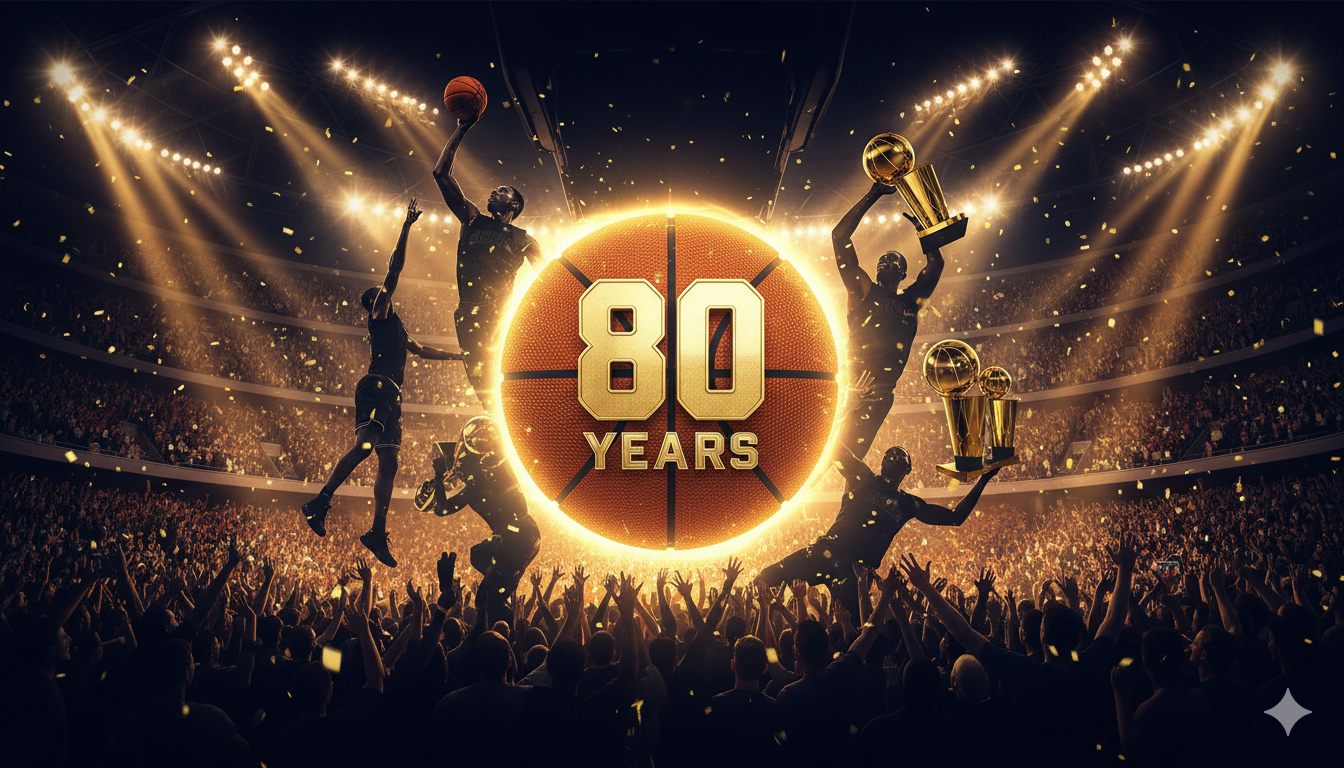
I sat down and continue to wonder how the year 2026 turns out to mark a monumental milestone in professional sports: the NBA 80th Anniversary. Since its inception in 1946 as the Basketball Association of America (BAA), the National Basketball Association has evolved from a fledgling regional attraction into a multi-billion-dollar global cultural phenomenon.
From the little days, where we watch out Dad’s and Uncles watch Basketball on Television. For the modern fan, the speed of today’s game—defined by logo threes and position less basketball—can sometimes obscure the foundational moments that made this era possible. Understanding the NBA’s legacy isn’t just about nostalgia; it’s about recognizing the tactical, social, and commercial shifts that allow the league to thrive 80 years later.
As we celebrate this platinum-plus milestone, we are revisiting eight historic moments that represent the DNA of the league. These aren’t just box scores; they are the pivots that changed the trajectory of the game forever.
1. The Tip-Off: Knicks vs. Huskies (November 1, 1946)
Every legacy has a “Day Zero.” For the NBA, it was a Friday night at Maple Leaf Gardens in Toronto. The New York Knickerbockers faced the Toronto Huskies in the first-ever game of the BAA.
- The Context: Tickets ranged from $0.75 to $2.50. Anyone taller than the Huskies’ tallest player (6’10”) got in for free.
- The Impact: The Knicks won 68–66. While the play was rudimentary compared to today’s standards, this game proved that professional basketball could function as a high-level spectator sport in major North American markets.
- Modern Legacy Connection: This moment birthed the concept of “NBA Global Games.” In 2026, the league’s presence in Mexico City, Paris, and Abu Dhabi is a direct descendant of that first international jump ball in Canada.
- Who Carries the DNA? Current international stars like Luka Dončić carry the torch of the “global pioneer,” proving the game’s roots were always meant to be borderless.
2. Wilt Chamberlain’s 100-Point Game (March 2, 1962)
In 1962, Wilt Chamberlain did the unthinkable by scoring 100 points in a single game against the New York Knicks in Hershey, Pennsylvania.
- The Logic: Chamberlain played all 48 minutes, shooting 36-of-63 from the field and an uncharacteristic 28-of-32 from the free-throw line.
- The Authority: According to the Naismith Memorial Basketball Hall of Fame, this remains the most “unbreakable” record in sports history.
- Modern Legacy Connection: Wilt’s dominance forced the NBA to widen the lane and change goaltending rules. Today, his legacy is felt in the “Efficiency Era,” where teams hunt for high-percentage shots, though now those shots are dunks or corner threes.
- Who Carries the DNA? Joel Embiid and Nikola Jokić. They mirror Wilt’s ability to bend the entire geometry of the court through sheer individual gravity.
3. The 1979 NCAA Championship: Bird vs. Magic
Technically a college game, the 1979 matchup between Larry Bird and Magic Johnson is arguably the most important moment in NBA history. It birthed the rivalry that saved a dying league.
- The Problem: In the late 70s, the NBA suffered from low ratings and tape-delayed Finals.
- The Solution: Bird and Magic brought their rivalry to the Celtics and Lakers. They represented the “Perfect Binary”: East vs. West, Blue Collar vs. Showtime.
- Modern Legacy Connection: This rivalry established the “Superstar Marketing” model. The NBA realized fans don’t just follow teams; they follow individuals.
- Who Carries the DNA? The 2026 rivalry between Anthony Edwards and Victor Wembanyama. Like Bird and Magic, they represent two different philosophies of the game but share a singular competitive fire that drives league-wide ratings.
4. The 1992 Dream Team: Global Expansion
Before 1992, NBA players were barred from Olympic competition. When the “Dream Team” took the floor in Barcelona, they didn’t just win gold; they colonized the global sporting imagination.
- The Roster: Jordan, Johnson, Bird, and Barkley. They won by an average of 43.8 points.
- The Result: This moment inspired a generation of international players. In 1992, there were 21 international players; by the 2025-26 season, that number exceeds 125.
- Modern Legacy Connection: The “Dream Team” made the NBA a lifestyle brand. The explosion of basketball fashion and sneaker culture in 2026 can be traced back to the global marketing blitz of Barcelona.
- Who Carries the DNA? Giannis Antetokounmpo. He is the ultimate realization of the Dream Team’s mission—a kid from Athens who saw the superstars of the 90s and became one himself.
5. Michael Jordan’s “The Last Shot” (June 14, 1998)
The climax of the Bulls’ dynasty was Game 6 of the 1998 Finals. Jordan’s steal and subsequent jumper solidified his status as the “G.O.A.T.” for a generation.
- The Moment: With seconds left, Jordan utilized a subtle (and debated) push-off on Byron Russell to drain a 20-foot jumper.
- Commercial Impact: It remains one of the most-watched games in NBA history, peaking at over 35 million viewers.
- Modern Legacy Connection: This shot defined the “Clutch Gene” narrative that dominates 2026 sports media. The league even created the “Jerry West Clutch Player of the Year” award to honor this specific type of high-stakes mastery.
- Who Carries the DNA? De’Aaron Fox and Kyrie Irving. They are the modern masters of the “iso-mid-range” when the game is on the line, mimicking Jordan’s late-game composure.
6. Kobe Bryant’s 81-Point Masterpiece (January 22, 2006)
Kobe Bryant’s 81 points against the Toronto Raptors occurred in the modern, televised age, proving that Wilt-like numbers were still possible in the 21st century.
- The Context: The Lakers were trailing by 18 in the third quarter. Kobe took over, scoring 55 points in the second half.
- Expert Tip: To truly appreciate this, watch the “Shot Quality.” This wasn’t just transition layups; it was a clinic in footwork and contested perimeter shooting.
- Modern Legacy Connection: Kobe’s performance ushered in the “High-Volume Scoring Era.” In 2026, seeing a player score 70 is no longer a “once-in-a-lifetime” event but a seasonal occurrence.
- Who Carries the DNA? Devin Booker and Jayson Tatum. Both have adopted the “Mamba Mentality” technical footwork and the willingness to take—and make—the most difficult shots on the floor.
7. LeBron James and the 3-1 Comeback (June 19, 2016)
No team in Finals history had ever come back from a 3-1 deficit until the 2016 Cleveland Cavaliers faced the 73-win Golden State Warriors.
- The Significance: LeBron James fulfilled his promise to Cleveland. His “The Block” on Andre Iguodala is considered one of the greatest defensive plays ever.
- Modern Legacy Connection: This win solidified the “Player Empowerment” era. LeBron proved that superstars could dictate their own destinies and still reach the mountaintop.
- Who Carries the DNA? LeBron James himself. Even in 2026, his unprecedented longevity serves as a living bridge between the NBA’s 60th and 80th anniversaries.
8. The 3-Point Revolution: Stephen Curry (2015–Present)
History isn’t just in the past. Stephen Curry didn’t just win championships; he changed the “math” of basketball.
- The Shift: In the 2000s, teams averaged ~15 three-point attempts per game. In 2026, many teams average over 40.
- The Authority: Data from Second Spectrum shows that Curry’s “gravity” has fundamentally altered defensive spacing.
- Modern Legacy Connection: The “Logo Three” is now a standard part of player development. High school recruits are now judged on their shooting range before they ever step into a college gym.
- Who Carries the DNA? Caitlin Clark (WNBA) and Tyrese Haliburton. They have embraced the “unlimited range” philosophy that Curry pioneered, making the half-court line the new starting point for defensive pressure.
Era Comparison: The 80-Year Evolution
| Feature | 1946 (Origin) | 1986 (Bird/Magic) | 2026 (Modern) |
| Average Points/Game | ~67 | ~110 | ~116 |
| 3-Point Line | Non-existent | Minimal Use | Primary Weapon |
| Global Presence | USA/Canada only | Emerging | 200+ Countries |
| Primary Position | The Center | The Forward | Positionless |
| Average Player Height | 6’2″ | 6’7″ | 6’8″ (with 7′ wing spans) |
NBA 80th Anniversary
Q: When is the official NBA 80th Anniversary?
A: The 80th season officially begins in October 2025, with the 80th anniversary of the first game falling on November 1, 2026.
Q: Will there be an “NBA 80” list of the greatest players?
A: Historically, the NBA releases updated lists during decade milestones. Expect an “NBA 80” list to be announced during the 2026 All-Star Weekend, likely including names like Nikola Jokić and Giannis Antetokounmpo.
Q: Who is the highest scorer in NBA history as of 2026?
A: LeBron James continues to hold the record for most career points in the regular season, a record he broke in 2023.
Q: Why was the 24-second shot clock created?
A: To prevent teams from stalling. In 1950, a game ended 19–18. The shot clock was introduced in 1954 to ensure a faster, more entertaining pace.
The Next 80 Years
The NBA 80th anniversary is more than a celebration; it is a launchpad. From the 1946 tip-off to the positionless marvels of 2026, the league has thrived by being the most adaptable organization in professional sports. As we look toward the 100th anniversary, the DNA of Wilt, Jordan, and Curry will continue to mutate into even more spectacular forms.
Key Takeaways
- Evolution is Constant: The game moved from a 19-point slog to a 116-point track meet.
- Rivalries Drive Growth: Individual narratives like Bird/Magic and Edwards/Wemby are the league’s lifeblood.
- Globalism is the Future: The NBA is no longer an American league; it is a global entity with a diverse talent pool.
Call-to-Action: Share your favorite NBA memory in the comments below, and subscribe to our newsletter for weekly deep dives into basketball’s tactical history.